
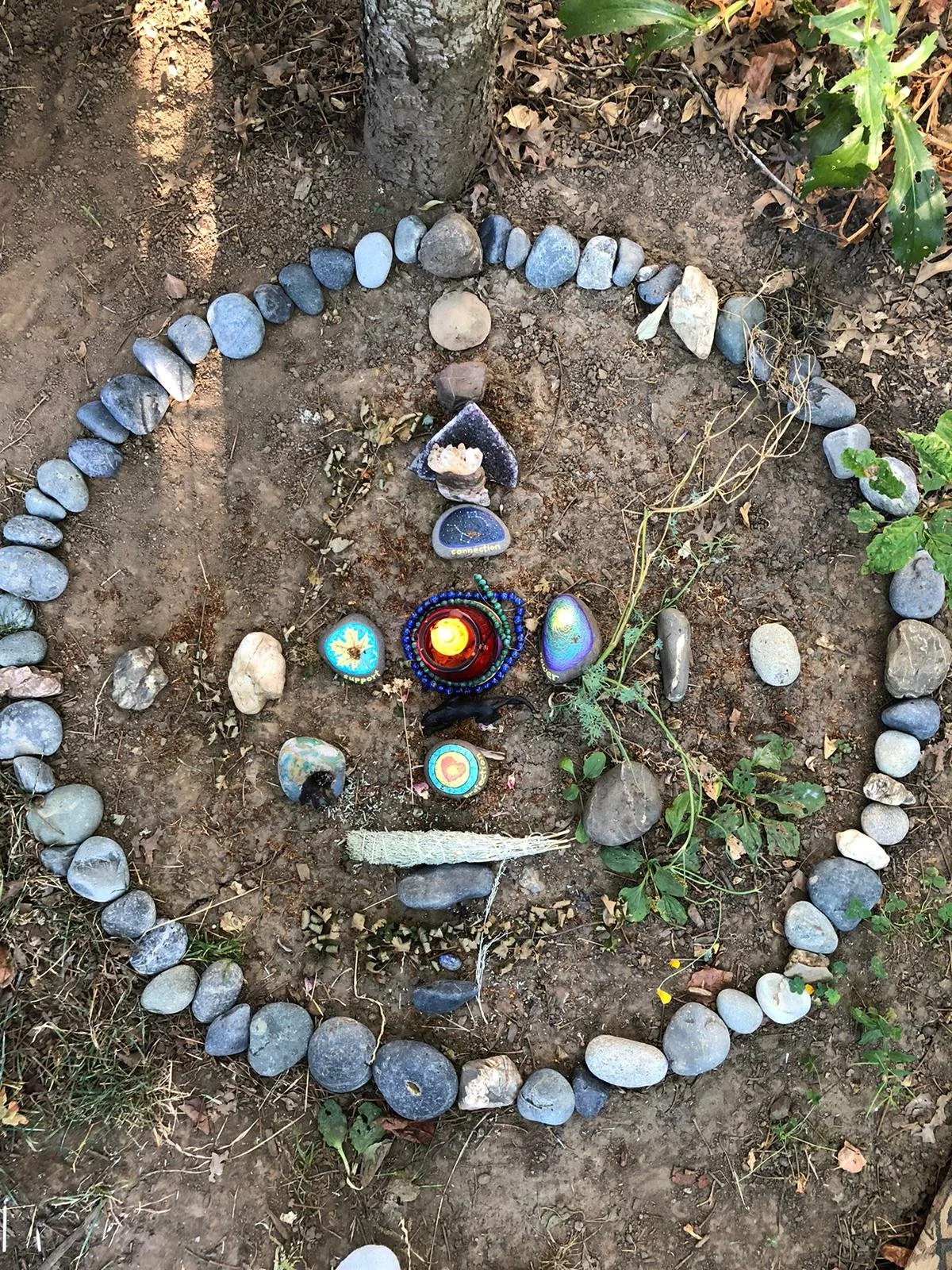
Tending the Sacred: Awakening Your Own Inner Knowing
There comes a point for many people when traditional frameworks for healing and growth begin to feel… incomplete.
Therapy may have helped you understand your patterns.
Coaching may have supported you in moving forward.
Retreats may have opened something beautiful inside you.
And yet—there can still be a quiet knowing: there is more here.
The Tending the Sacred program was created for that “more.”
Why Someone Chooses This Path
This work tends to call people rather than convince them.
It’s for those who:
Feel they are on a spiritual or soul-centered path
Have had openings, intuitive experiences, or moments of awakening
Sense untapped gifts or sensitivities they don’t yet know how to hold
Long for depth, community, and integration, not just peak experiences
Are committed to their own healing—not as a quick fix, but as a lifelong unfolding
Many people arrive here after realizing that healing is not a straight line from broken to fixed. It’s a spiral. A descent and return. A remembering.
This program offers a space to walk that spiral with support.
Not a Quick Fix—A Deepening
Tending the sacred is not about bypassing pain or “getting rid” of difficult emotions.
In fact, it often asks the opposite.
There are moments in this work where you may meet parts of yourself you’ve never faced before—old grief, shadow aspects, forgotten truths. Not as problems to eliminate, but as pieces of your wholeness asking to be seen.
This is why the work requires:
Readiness
Support
Skilled guidance
It is not a magic pill. It is a relationship—with yourself, with the unseen, and with life itself.
How This Is Different from Therapy, Coaching, and Retreats
Each of these modalities has real value. This work doesn’t replace them—it moves alongside and beyond them.
Therapy often focuses on healing the past and creating stability.
Coaching tends to orient toward goals, performance, and forward movement.
Retreats can offer powerful openings, insights, and breakthroughs.
The Tending the Sacred program weaves something different:
An ongoing container rather than a one-time experience
Spiritual and soul-level work, not just psychological or behavioral
Integration over intensity
A relationship to the unseen, the symbolic, and the imaginal
Embodied practices that bring insight into lived reality
Instead of asking, “How do I fix this?”
We begin to ask, “What is trying to emerge through me?”
Not About Following—About Remembering
Many spiritual paths, even well-intentioned ones, can become rigid—offering a specific way to see, practice, or interpret the spiritual world.
But the sacred is not one-size-fits-all.
At its heart, Tending the Sacred is not about teaching you what to believe or asking you to adopt someone else’s framework.
It is about awakening you to your own.
Your own inner knowing.
Your own intuitive language.
Your own direct relationship with spirit.
Rather than positioning the teacher as the authority, we see ourselves as guides—helping you learn how to listen, discern, and trust what arises within you.
This is not about dependency.
It’s about sovereignty.
Not about giving you answers,
but helping you become someone who knows how to find them.
Choosing a Teacher: What Matters
This kind of work requires discernment.
Not all spaces that speak the language of spirituality or healing are grounded, ethical, or safe.
When choosing a teacher or program, it’s important to feel into:
Integrity — Do they walk what they teach?
Humility — Do they guide rather than position themselves as authorities over your truth?
Trauma awareness — Can they safely hold complex emotional processes?
Respect for autonomy — Are you empowered, not made dependent?
Depth over performance — Is the focus on real transformation, not spiritual image?
A good teacher doesn’t ask you to give your power away.
They help you come back into right relationship with it.
Why Choose This Program
The Tending the Sacred program was created with deep care for the nuance and responsibility of this work.
What makes it distinct:
A Grounded Approach to Spiritual Work
This is not about escaping reality—it’s about inhabiting it more fully. Spiritual experiences are integrated into the body, the nervous system, and daily life.
Trauma-Informed and Compassionate
We understand that opening spiritually can also open emotionally. The space is designed to support both with care and skill.
Community as Medicine
This path can feel isolating. Here, you are met by others walking a similar terrain—sensitive, intuitive, and committed to growth.
Structure + Mystery
There is both container and openness—practices, teachings, and frameworks alongside room for the unknown, the symbolic, and the emergent.
Development, Not Just Healing
This is not only about resolving wounds. It’s about maturing into who you are becoming—what some might call soul development.
A Living Path
Ultimately, this work is not something you complete.
It’s something you enter.
A relationship that evolves over time—between you and your inner world, your gifts, your challenges, and the deeper intelligence moving through your life.
If you feel the pull toward this kind of work, it’s worth listening.
Not rushing. Not forcing.
Just listening.
Because often, the path begins there.

The Path of Becoming
At any instant, we are Becoming; however, Becoming is mostly unconscious. Becoming in the conscious, spiritual sense is intentional. It is about fully occupying our body until we sense our pure Being.
For example, we feel our hearts. Our hearts love, yearn, fill with joy, can be traumatized, can break, and can mend. What we practice is allowing our hearts to open to the spiritual heart. The spiritual heart is the universe and our hearts are a part of that. When we open our hearts to our spiritual heart, we deepen our connection with the earth and the universe. Our sense of belonging becomes conscious. When this transformation is guided within in a safe, welcoming community with trusted teachers, our hearts are free to welcome the opening. Intentional practice and sharing facilitate our transformation.
The Path of Becoming is enriched when we combine this Zen approach—cultivating present-moment awareness, clarity, and non-attachment—with earth-based, contemporary shamanic practices. Meditation, somatic awareness, and mindfulness interweave with visionary and nature-centered rituals, creating a holistic framework for meeting each moment fully. This integration supports not only personal transformation but also a conscious, embodied connection with the world around us, fostering a sense of guidance, groundedness, and ethical presence in our daily lives.
For those who feel called to explore this path more deeply, programs in spiritual leadership offer structured opportunities to practice these principles in community. Whether through guided journeys, shared reflection, or earth-based rituals, such programs provide a container to deepen awareness, strengthen the heart, and cultivate the skills to hold transformative work—for oneself and for others.
A Moment to Practice Becoming
Even outside a formal program, you can begin to explore the Path of Becoming in daily life. Take a few moments each day to settle into your body, notice your breath, and sense your heart. Allow yourself to feel what is present without judgment—joy, tension, grief, or yearning—and gently open to the wider awareness that connects you to the earth and the world around you. Over time, these small practices cultivate a lived sense of presence, grounding, and conscious participation in life—a practice of Becoming that unfolds in every moment.
For those interested in exploring this path in community, our two-year Spiritual Leadership Training offers guidance, practices, and support to develop your capacity for conscious, heart-centered leadership.’
Written by Analouise Williams, PhD and Amy Kelchner, ND
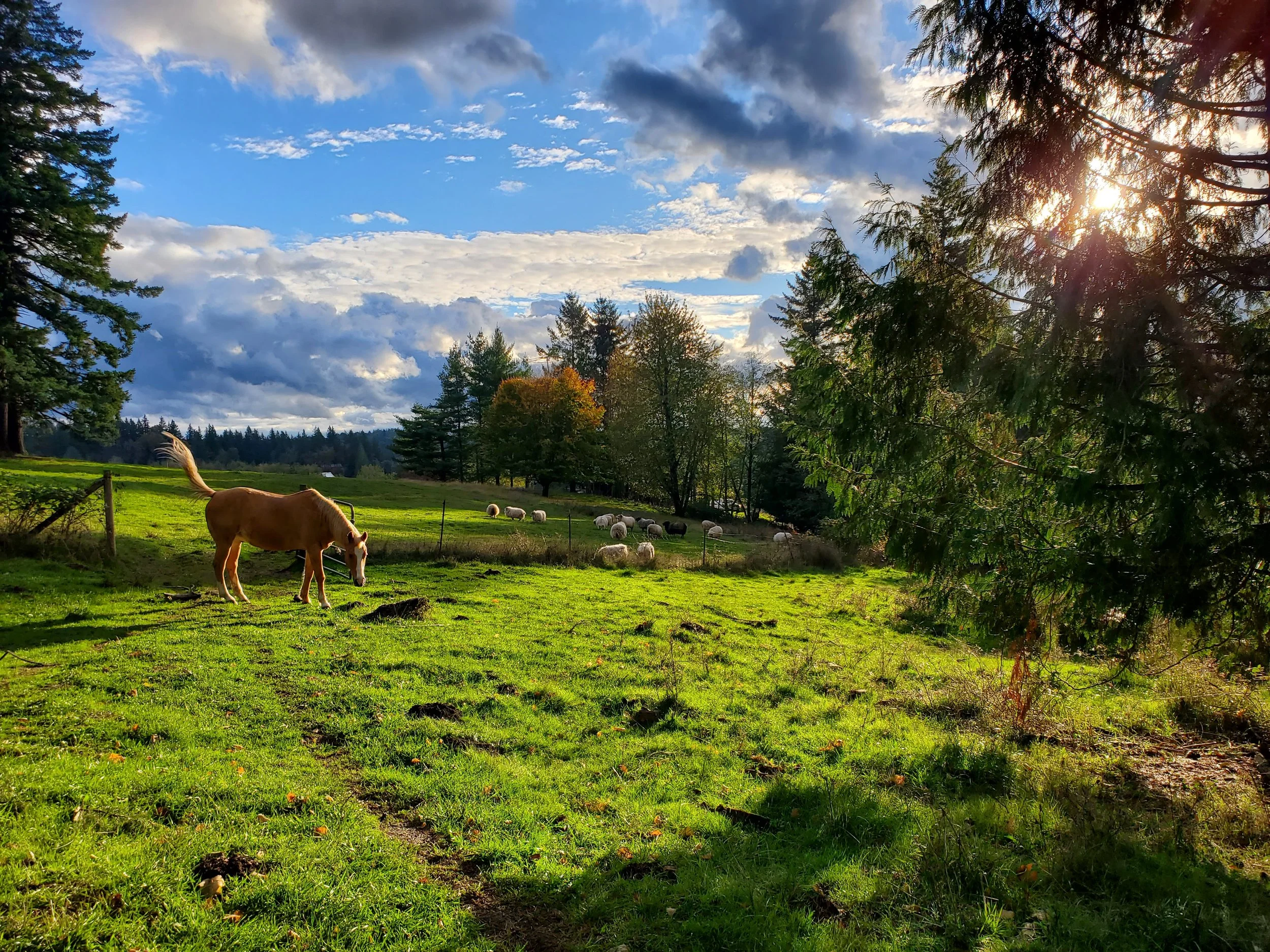
The Spirit of Place
The Farm where we hold our Spiritual Leadership training
Reconnecting with the land
by Laura Hysen
We may travel to experience inspiration and the natural wonders of the Earth - the quiet beauty of the mountains, the ruggedness of the high desert, the simplicity of paddling on a serene lake. In these places, something deeper than visual beauty moves us. We are called to connect with the spirit of the Earth.
The spirit of place, or genius loci, transcends words and the mental plane. It is something we feel about a place and it may involve all of the senses in that exploration. Depending on one’s perspective, you may experience the multi-dimensional embrace of land guardians, divine beings and nature spirits. We may gain a deeper sense for how the plants, animals and elements synergize in mutual cooperation.
However, we need not travel too far to attune to the harmonics of the Earth, as we can connect with the spirit of nature in our own backyards and other local spaces.
“This is a place for joy. Share it with others.”
That is what the land said to me when I asked, “What is our work on this property?”
The land I’m referring to is a 40-acre organic farm near Corbett, Oregon and my husband and I have been the grateful stewards of it for nearly 20 years. It is a land of rolling hills and big sky views. It feels private yet quietly connected to the surrounding community. Its rustic beauty and modest structures reflect the intention to live in harmony with the land.
With a healthy mix of pasture-friendly livestock, we steward not only the plants, trees and wildlife, but also a small herd of cattle, sheep, two horses and some chickens. We have hosted retreats for individuals and small groups, as well as many farm visits with friends and family.
Farm life comes with large workloads and other challenges. However, the rewards we have experienced are truly beyond words: it is the deep privilege of sharing in the joy that others experience during their visits.
Joy and connection. In service to this purpose, I am honored to co-facilitate and host the Tending the Sacred program on this land. If you find yourself called to join the program, the spirit of this land supports our ability to feel grounded, to quiet our minds, open our hearts and listen.
The Earth has messages for us.
Wherever we are in the world, we can facilitate our own reconnection with the spirit of the land, even in our own backyards. It only requires a few moments of presence and connection with our breath, with our feet rooted to the Earth.
The land invites us to remember that we all belong to the Earth. All of the people, plants, animals, insects, microbes- all of us belong here. The Earth will help us rediscover that we each have something unique to contribute in service to life on this planet.
Ethical Spiritual Leadership
Ethical spiritual leadership begins with humility. A spiritual leader is not the source of wisdom but a steward of a process. Many traditions describe this as becoming a hollow bone or an open channel, allowing love, spirit, and insight to move through rather than accumulating it as personal authority. When the work is aligned, the practitioner steps slightly to the side so that something larger can speak.
Ethical Spiritual Leadership: Walking the Path With Integrity
by Amy Kelchner, ND
Spiritual leadership carries a quiet gravity. When people seek spiritual guidance, they are often tender, searching, or standing at the threshold of change. They may be grieving, awakening, healing, or asking questions that reach to the roots of their lives. In those moments, the role of a spiritual leader is not to gather power or admiration, but to hold a clear and ethical container where healing and wisdom can emerge.
This is one of the central intentions behind our Spiritual Leadership Training: to cultivate practitioners and guides whose work is grounded not only in spiritual depth, but in ethical awareness, humility, and relational responsibility.
Ethical spiritual leadership begins with humility. A spiritual leader is not the source of wisdom but a steward of a process. Many traditions describe this as becoming a hollow bone or an open channel, allowing love, spirit, and insight to move through rather than accumulating it as personal authority. When the work is aligned, the practitioner steps slightly to the side so that something larger can speak.
But this ideal requires grounding in ethics, self-awareness, and care.
A Trauma-Informed Approach to Spiritual Work
Trauma-informed spiritual leadership recognizes that many people carry histories of harm, neglect, and power imbalance. In this context, a trauma-informed approach means understanding how trauma shapes the nervous system, perception, and relational dynamics. It means prioritizing safety, consent, choice, and empowerment.
A trauma-informed spiritual practitioner does not assume authority over another person’s experience. They do not interpret someone’s inner world in a way that overrides the individual’s own knowing. Instead, they support people in reconnecting with their own wisdom, pacing the work in ways that respect emotional and somatic capacity.
Practically, this means:
• honoring clear boundaries
• asking permission before offering spiritual interpretations
• avoiding grand claims about healing or transformation
• respecting the autonomy and agency of each participant
Spiritual guidance should expand a person’s sense of self and sovereignty, not narrow it.
Power Dynamics and the Risk of Energetic Enmeshment
Spiritual work can create powerful relational fields. When someone enters a ritual, a meditation space, or a deep healing process, vulnerability naturally increases. This can unintentionally produce a kind of energetic entanglement between practitioner and participant.
Without awareness and clear boundaries, this dynamic can slip into energetic enmeshment. The practitioner may become overly involved in another person’s process, feel responsible for their healing, or subtly draw validation and identity from the role of “the healer.”
In more troubling situations, spiritual authority can be used to take advantage of others. This might appear as:
• claiming special access to truth or spiritual power
• encouraging dependence on the practitioner
• blurring relational, emotional, or financial boundaries
• using spiritual language to override consent or questioning
Even subtle forms of influence can erode a person’s sense of agency. Ethical spiritual leadership requires ongoing awareness of these dynamics and a commitment to preventing them.
The goal is not to hold power over others but to return power to them.
The Responsibility of Personal Practice
Spiritual leadership cannot rest solely on techniques, certifications, or teachings. It must be rooted in a living, ongoing practice. Meditation, prayer, time on the land, ritual, contemplation, and earth-honoring practices help practitioners remain grounded and aligned.
This daily tending acts like clearing a channel. Without it, ego, ambition, and unconscious needs can slowly cloud the work.
A spiritual leader who is not in active relationship with their own practice can easily begin drawing energy from the people they are guiding. Attention, admiration, and emotional intensity can become a substitute for genuine spiritual nourishment.
A consistent practice helps maintain the orientation of service rather than extraction.
Shadow Work and Self-Awareness
Ethical spiritual leadership also requires an honest relationship with one’s own inner landscape. Every practitioner carries personal history, wounds, biases, and unconscious patterns.
Shadow work is the ongoing process of bringing those unseen aspects into awareness. It includes examining:
• emotional triggers
• projections onto others
• cultural and personal biases
• desires for validation, control, or belonging
Without this work, a practitioner may unknowingly shape spiritual guidance around their own unmet needs or unresolved material.
Self-reflection, mentorship, supervision, and community accountability are all ways of keeping the work honest.
Spiritual Leadership as Stewardship
Ultimately, ethical spiritual leadership is less about leading and more about stewarding a space where wisdom can emerge.
The practitioner becomes a careful gardener rather than the source of the garden’s life. They tend the soil, protect the boundaries, and ensure that the conditions are healthy for growth. The real intelligence of healing arises from the participant, from relationship, and from the larger field of spirit or life itself.
When practiced with integrity, spiritual leadership restores something essential: a person’s relationship with their own inner knowing.
And in that moment, the practitioner has done their work well.
Not by gathering power.
But by letting it flow through, like wind moving through an open hollow bone.
About the Training
Our Spiritual Leadership Training is a two-year, practice-based program designed for seekers, healers, therapists, and guides who feel called to support others in meaningful spiritual work. Rooted in mindfulness, somatic awareness, earth-honoring ritual, and transpersonal approaches to healing, the program begins with deep personal practice and gradually moves into learning how to ethically hold space for others.
Throughout the training, we explore the foundations of trauma-informed spiritual care, personal practice, shadow work, and the ethical responsibilities that come with guiding people through profound inner experiences. The intention is not to create gurus or authorities, but to cultivate grounded, humble practitioners who can serve as clear channels for wisdom, compassion, and transformation.
If you feel called to walk this path, you can learn more about the program here:
https://www.tendingbodyandsoul.com/spiritual-leadership-training 🌿